
Quantum Materials and Devices
Summary
Our research spans from exploring basic Physics in reduced dimensionality systems to building novel devices for applications. From a fundamental Physics standpoint, small is often different. A prime example of this is the difference between the quantum and the classical worlds. We seek to gain fundamental understanding of quantum effects and other novel Physics at nanoscales. Charge, spin and thermal transport measurements performed at low-temperatures in our lab offer a versatile probe into these properties. The unique insights uncovered by these studies are used to guide material and device design for different applications.
Ongoing projects include measuring speed limits of quantum entanglement, thermoelectric effects at cryogenic temperatures, and the impact of phonon engineering on spin qubit relaxation and decoherence.
We are always looking for motivated undergraduate and graduate students to join our group. The best time to contact me if you are interested in joining us is February for undergraduate students and September through December for graduate students.
Group News
- Kirsten Blagg graduated in December 2021 with a Ph.D. Congratulations Dr. Blagg! We will miss having you around.
- Honored to receive NSF’s CAREER award (Feb 2021).
- Our paper appeared today in PRX Quantum! LINK This was part of three Quantum roadmaps paper, a new article type for APS, of which our three are the first examples.
- Our work on developing an on-chip mask-free thermometer sensitive down to 8 milliKelvin was published in Carbon (LINK).
- Our user proposal related to gate-defined quantum dots was accepted at CINT, Sandia National Lab (June 2020).
- Congratulations to Joel Howard for winning the NSF QISE-NET Triplets Fellowship (February 2020). Our Triplets partner is Raymond Simmons, NIST Boulder.
Current Grants
- NSF: Collaborative Research: NRT-QL: A Program for Training a Quantum Workforce (2021-2026)
- NSF: CAREER: Electron-phonon processes in gate-defined silicon quantum dots: measurement, control, and applications (2021-2026)
- NSF: Defect States of Silicon Allotropes for Quantum Information Science (2021-2024)
- NSF: MRI: Acquisition of an Automated, Variable Temperature and Magnetic Field Multi-property Measurement System (2019-2022)
- NSF: Thermoelectric Effects in Superconductor Ferromagnet Hybrids (2018-2022)
- NSF: RAISE-TAQS: Entanglement and information in complex networks of qubits (2018-2022)
To learn more about these projects and other ongoing efforts, please visit the ‘research’ tab. The dates in parenthesis above refer only to the grant durations – related research following up on these studies almost always continues beyond the expiration of the grant.
Contact
Meenakshi Singh
Coorstek Center for Applied Science and Engineering
Colorado School of Mines
Golden, CO 80401
303-273-3844
msingh@mines.edu
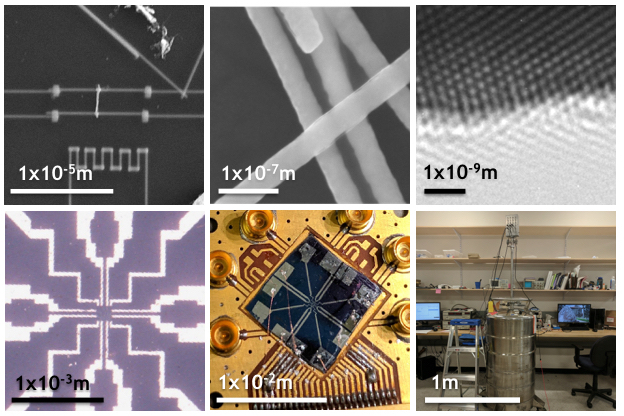
Powers of 10
Length scales of systems of interest in our lab
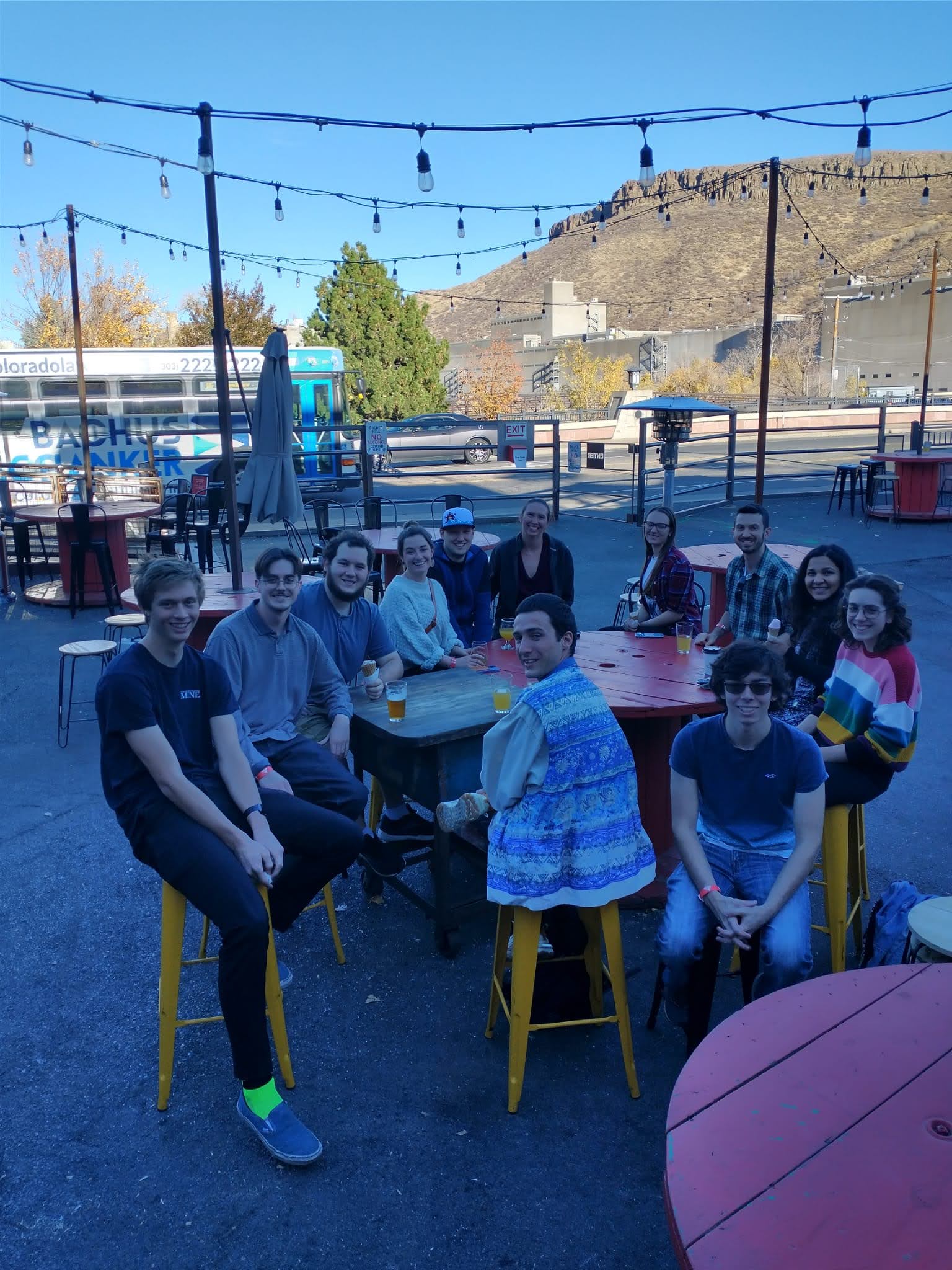
Group celebration
Kirsten’s graduation celebration at Golden Mill
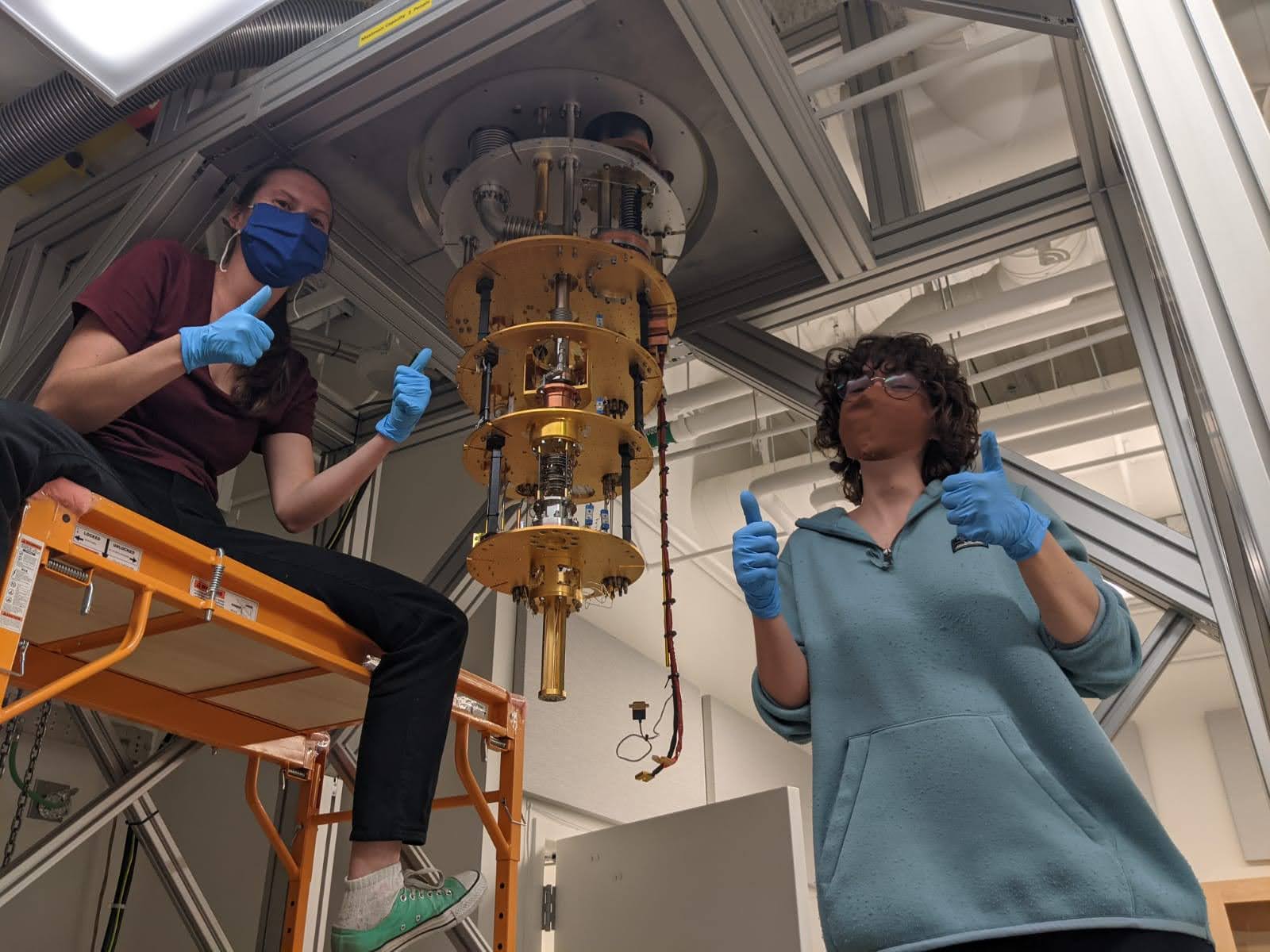
A day in the lab
Installing filters in the dilution fridge
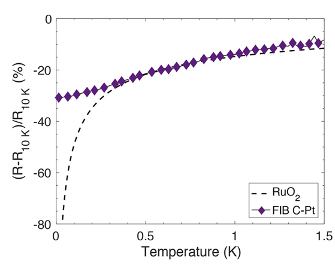
Cryogenic on-chip thermometer
This cryogenic C-Pt thermometer developed in our lab can be deposited on-chip in a lithography free process